Free Stuff
My sheet music and other free resources are available here. Just follow this link.
These things are under a Creative Commons license that allows you to download them and copy them freely—for any non-commercial use.
Enjoy!
Store
I have books, CDs, and a video series for sale from my store page. (I wish I could just give everything away, but one must eat!)
I’m especially excited about my new book, now available: My Burden Is Light: A Pastor’s Plea for Rationality, Honesty, and Humility.

About
Merry, Mystical Missives
Here you’ll find everything I’ve sent out to the mailing list for The Merry Mystic.
Live Lovingly
Hello, Merry Mystics,
Here’s something decidedly more mystic than merry: a long slow chant called “Live Lovingly.” It’s more rhythmic than plainsong, but melodically, I was going for a medieval church-mode feel. (But what do I know? I’ve never really studied that stuff, and I barely know a Hypodorian from a midi-chlorean.)
Anyway: sit back, relax, light a candle, and have a listen. And live lovingly.
Service with a Smile
Hello, Merry Mystics!
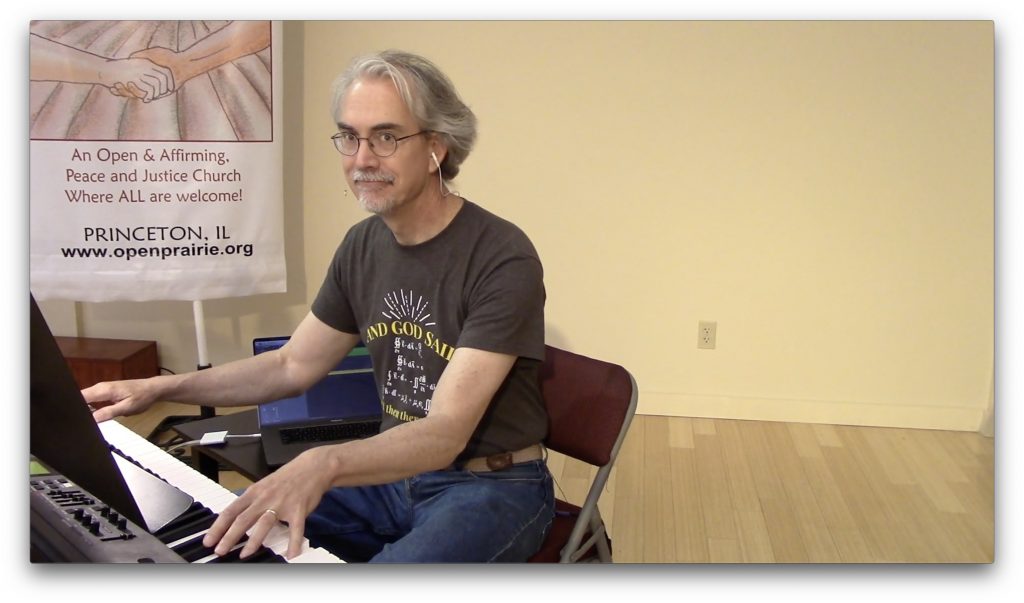
In my church, this was Week Six of my songwriting challenge: I’ve been preaching on the ethical teachings of Jesus, and writing a new song to go with each one. Most weeks, I’ve written a new hymn, and my congregation has been very game about learning to sing new music every week. But I thought they needed a break, so this week I wrote something for me to sing to them—Merry Mystic style. As you can see, I’m very lucky to be serving a church that lets me bust out with a song like this in the middle of a sermon.
It’s all about service: service with a smile!
Honesty
Hello, merry and mystical friends!
My songwriting challenge continues this week. The subject this time is honesty: a time-honored teaching of the Hebrew tradition, to which Jesus added his own unique twist. The hymn I’ve written is just called “Truth”, and that’s what it’s about: speaking truth in love, speaking truth to power, living truthfully, praying truthfully, and all that good stuff.
There’s a story in Chapter 18 of the Gospel of John about a meeting between Pontius Pilate and Jesus. At one point, Jesus says, “For this I was born, and for this I came into the world, to testify to the truth. Everyone who belongs to the truth listens to my voice.” Pilate responds, “What is truth?” I never know how to read that line aloud. Is it a world-weary but honest question? Is Pilate mocking Jesus—so I should read it with a bit of an eye roll? Or is Pilate introducing Late Antiquity’s version of postmodern philosophy?
What is truth? I don’t know. Or, to express my ignorance in a more educated way, I might answer him: “Pontius—can I call you Pontius—the instability of your question leaves me with several contradictorily layered responses whose interconnectivity cannot express the logocentric coherency you seek. I can only say that reality is more uneven and its (mis)representations more untrustworthy that we have time here to explore.” (That’s quoted from Stephen Katz, “How to Speak and Write Postmodern”, in The Truth about the Truth, Walter Truett Anderson, ed.) Maybe Pilate would be so confused by that answer that he’d forget to have me flogged.
What is truth? I don’t know, but I know God knows, so I wrote this hymn. As always, sheet music for “Truth” is available in our Free Stuff area.
We Built a Clubhouse, Snug and Tight
Merry meet again, Merry Mystics!
My songwriting challenge continues this week. The subject this time is universal solidarity: a teaching that Jesus rarely spoke about, but often demonstrated. The hymn I’ve written has a sort of childish melody, because it’s about our childish impulse to exclude people from our clubhouse.
As always, sheet music for “We Built a Clubhouse, Snug and Tight” is available in our Free Stuff area.
These are the (mostly video) messages sent out to The Merry Mystic mailing list.
Sermons and Such
Every week, I preach in the Open Prairie United Church of Christ in Princeton, Illinois. I’m not sending most of these out to The Merry Mystic mailing list; but on the outside chance you’d like to see a sermon, here they are.
Authority
Here are two authority challenges: recognize Jesus’ authority, and claim your own.
Peace! Be Still!
Calming the storm: the storm outside, and the storm inside.
Kingdom Call, Kingdom Response
God calls to the seed, and to us: come forth!
Live Lovingly, Again: Against Pride of Belief
Jesus was far more interested in how people behave than in what they believe. We should be too. Live lovingly!
A Pineapple of Compassion
This Sunday, we read a story from the Gospel of Mark about a disagreement Jesus had with some Pharisees concerning proper observance of the Sabbath. Deep inside the story is a beautiful teaching of Jesus—a teaching that’s important, whether you work on the Sabbath or not.
Invitation to the Deep End
Before John 3:16—the best-known passage in the New Testament—the gospel writer invites us to go deep.
Youthful Visions
It makes me happy when children come to church. In this Pentecost reflection, I explain why. (The Pentecost story was dramatized by three voices before my reflection; here, I only repeat one verse of it.)
Help Reaching Decisions
The eleven remaining apostles chose a twelfth to replace Judas. Looking at how they did it can teach us some useful things about our own decision making.
Psalm 23, Mothers Day Version
Here’s a prayer for Mothers Day, with some reflections about the 23rd Psalm.
On Hitting Back Harder
Jesus taught something very challenging about how to respond to violence, and I talk about it in this sermon. This week, I also wrote a letter to the President (and others in Washington) about the current wave of student protests, and about the crisis in Israel and Gaza. I talk about that too.