Free Stuff
My sheet music and other free resources are available here. Just follow this link.
These things are under a Creative Commons license that allows you to download them and copy them freely—for any non-commercial use.
Enjoy!
Store
I have books, CDs, and a video series for sale from my store page. (I wish I could just give everything away, but one must eat!)
I’m especially excited about my new book, now available: My Burden Is Light: A Pastor’s Plea for Rationality, Honesty, and Humility.

About
Merry, Mystical Missives
Here you’ll find everything I’ve sent out to the mailing list for The Merry Mystic.
Body, Mind, Vine, and Fruit
My seminary brother Rob Pierson offered a whole pamphlet in response to my Siphonophore message last week. His is a more positive metaphoric understanding of community — not as a self-serving institutional organism, but as a relational expression of the mind of Christ. Rob has given me permission to share his pamphlet with you, so I’m attaching it below. Rob is a remarkable soul, and I recommend reading this, and anything else he writes. (I also recommend spending time with his photographic artwork, if you can find it. How’s that web site coming, Rob?)
The seminary Rob and I attended is the Earlham School of Religion. It’s a community rooted in the Quaker tradition, which is Rob’s faith family too, though not mine. A “pamphlet,” in that tradition, is a monograph inspired by the Spirit; it’s a time-honored medium for written ministry. In Rob’s pamphlet, you might find one or two terms that are used in unfamiliar, Quakerly ways: clearness committee, testimonies, business meeting, and so on. But his message is universal and accessible. I hope you’ll enjoy it.
That We May All Be One
In this issue of The Merry Mystic, I share a new hymn about unity.
Last week, I shared something from the book chapter I’m working on—my sequel to The Inn of God’s Forgiveness. I introduced a metaphor for self-serving institutions like states and churches, and I asked a question: what kind of unity should we be seeking? Thanks for all your responses! I’m still mulling them over, and I’ll be responding more soon.
Last week, I wrote:
I want to cast a hopeful vision about a different way to understand Jesus’ prayer, that they may all be one. Not one in race or caste or language; not one in national or political affiliation; not one in church or creed. I don’t think that God desires that any part of our beautiful diversity should be erased. I’ve written a hymn about this, and I’ll share it with you another time.
That time is now: here’s my hymn, “That We May All Be One.”
[youtube id=uSHz3C9vhe8]
Sheet music and lyrics for the hymn can be freely downloaded here, and may be freely copied (for non-commercial use).
Siphonophores
This week, instead of a video, I have some text to share with you: three pages from my next book. I’ve been working on this chapter for several weeks, but I think I need your input. I’m using an extended metaphor for institutions — including churches. Please read:
There’s a lot more, of course, but that’s the church metaphor I start with:

Now, here’s the wider context.
I am an ordained minister of the United Church of Christ, and the church I now serve as pastor is a part of that denomination. The motto of my denomination is, “That they may all be one.” This is a quotation from the Gospel of John, from a passage known as the Farewell Prayer (John 17:1-26). The UCC got its start back in 1957, when two previous denominations united: the Evangelical and Reformed Church, and the Congregational Christian Churches. And each of those two parent denominations was itself formed from the unions of two grandparent denominations, twenty some years before that. So we’re not just the United Church of Christ — we’re the Uniting Church of Christ, we’re all about uniting, and Jesus’ prayer, that they may all be one, has long been part of our dream.
But personally, I’ve always been a bit conflicted about that motto.
It can be a great thing, unity; it can be a great thing when people can transcend their differences and work together. There’s a feeling of unity, sometimes, in corporate worship. It’s a great feeling to be part of a team, in sports or in business, when that team is really working together and firing on all cylinders. It gives you motivation, and a sense of purpose, to be part of something bigger than yourself.
But on the other hand, people in Nazi Germany had that same sense of motivation, that same sense of being part of something bigger than themselves; and there is a drive for unity behind white power movements like the Klan; and there was a drive for unity behind some of the most evil and intolerant parts of Christian history, like the great inquisitions. Those things are not just historical oddities; they’re so common that I would say they’re typical of the way humankind has expressed the drive for unity. Typically, we seek unity by enforcing conformity, by policing dissidents, and by turning against outsiders. The drive for unity can be totalizing and destructive; it can be just a tool of the basic institutional drive to survive, eat, and grow.
So here’s a problem: unity can be a great good, or a great evil. It can be one of the most uplifting human experiences, or one of the most degrading. And so I’m conflicted about the motto, that they may all be one. It needs careful thought. We need to be very careful about the kind of unity we seek.
In this chapter of the book I am trying to cast a vision — two visions, really. First, I want to cast a cautionary vision about the siphonophoric nature of institutions; second, I want to cast a hopeful vision about a different way to understand Jesus’ prayer, that they may all be one. Not one in race or caste or language; not one in national or political affiliation; not one in church or creed. I don’t think that God desires that any part of our beautiful diversity should be erased. I’ve written a hymn about this, and I’ll share it with you another time.
But now, leave a comment, and tell me something: what kind of unity should we be seeking?
The Inn of God’s Forgiveness
In this issue of The Merry Mystic, I start by sharing a disturbing version of Jesus’ parable of the Prodigal Son. But don’t worry: I make up for it by singing a reassuring hymn, “The Inn of God’s Forgiveness.”
The hymn began as a dream. As I explain in the book:
In the dream, I was traveling a rough country trail on foot, carrying a heavy pack. Coming over a ridge at the end of day, I saw an inn below me, with a golden light shining out of its windows. I walked on toward it. But the closer I drew, the more timid I felt. Would I be welcome there, travel-stained as I was? Would there be many strangers? Could I afford it? I hesitated in the yard before the door. I thought of traveling on.
But the door opened, and the innkeeper stepped out to welcome me, and his strong son took the pack off my shoulders and carried it up to my room. “There’s your table, right over here,” they said, pointing to just the kind of quiet corner table that I like. And they were so beautiful, and the serving staff all so beautiful and bright, and I so dusty and tired. Why are all these beautiful people serving me, I wondered? How do they know what I want, before I ask for it? And why do they laughingly refuse any payment?
Sheet music for the hymn can be freely downloaded here, and may be freely copied (for non-commercial use). The book can be ordered here. (It isn’t free. What can I say? One must eat.)
These are the (mostly video) messages sent out to The Merry Mystic mailing list.
Sermons and Such
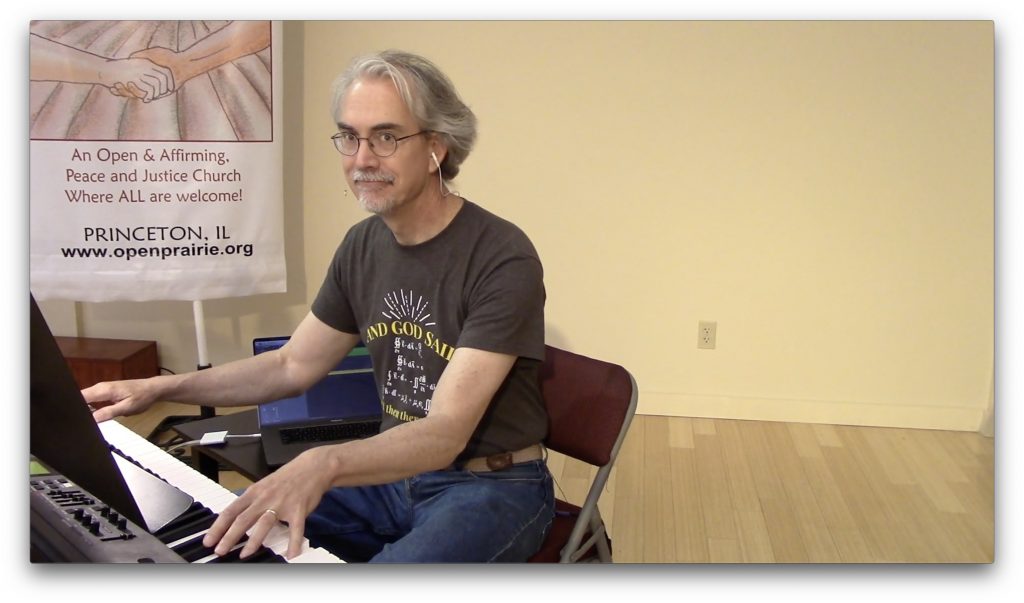
Every week, I preach in the Open Prairie United Church of Christ in Princeton, Illinois. I’m not sending most of these out to The Merry Mystic mailing list; but on the outside chance you’d like to see a sermon, here they are.